oggmap: Step 2 - gene age class assignment
This notebook will demonstrate how to extract an orthomap (gene age class) from OrthoFinder results or how to import pre-calculated orthomaps.
Notebook file
Notebook file can be obtained here:
https://raw.githubusercontent.com/kullrich/oggmap/main/docs/notebooks/get_orthomap.ipynb
Import libraries
[1]:
import numpy as np
import pandas as pd
import scanpy as sc
import seaborn as sns
import matplotlib.pyplot as plt
from statannot import add_stat_annotation
# increase dpi
%matplotlib inline
#plt.rcParams['figure.dpi'] = 300
#plt.rcParams['savefig.dpi'] = 300
plt.rcParams['figure.figsize'] = [6, 4.5]
#plt.rcParams['figure.figsize'] = [4.4, 3.3]
Import oggmap python package submodules
[2]:
# import submodules
from oggmap import qlin, gtf2t2g, of2orthomap, orthomap2tei, datasets
Use OrthoFinder results to get gene age classification
The query species in this part is: Danio rerio (zebrafish).
Please have a look at the documentation of Step 0 - run OrthoFinder to get to know what information and files are mandatory to extract gene age classes from OrthoFinder results.
Mandatory query species information:
query species sequence name (see header of <Orthogroups.GeneCount.tsv> or <Orthogroups.tsv> file) (
seqname=)query species taxonomic ID (
qt=)
Mandatory information fromOrthoFinderrun:
tab delimted file containing sequence name and taxonomic IDs of all species used (
<OrthoFinder name><tab><species taxID>) (sl=)
Mandatory files fromOrthoFinder:
<Orthogroups.GeneCount.tsv> or <Orthogroups.GeneCount.tsv.zip> (
oc=)<Orthogroups.tsv> or <Orthogroups.tsv.zip> (
og=)
In Step 1 - get taxonomic information you have already been introduced how to extract query lineage information with oggmap and the qlin.get_qlin() function.
[3]:
# get query species taxonomic lineage information
query_lineage = qlin.get_qlin(q='Danio rerio')
query name: Danio rerio
query taxID: 7955
query kingdom: Eukaryota
query lineage names:
['root(1)', 'cellular organisms(131567)', 'Eukaryota(2759)', 'Opisthokonta(33154)', 'Metazoa(33208)', 'Eumetazoa(6072)', 'Bilateria(33213)', 'Deuterostomia(33511)', 'Chordata(7711)', 'Craniata(89593)', 'Vertebrata(7742)', 'Gnathostomata(7776)', 'Teleostomi(117570)', 'Euteleostomi(117571)', 'Actinopterygii(7898)', 'Actinopteri(186623)', 'Neopterygii(41665)', 'Teleostei(32443)', 'Osteoglossocephalai(1489341)', 'Clupeocephala(186625)', 'Otomorpha(186634)', 'Ostariophysi(32519)', 'Otophysi(186626)', 'Cypriniphysae(186627)', 'Cypriniformes(7952)', 'Cyprinoidei(30727)', 'Danionidae(2743709)', 'Danioninae(2743711)', 'Danio(7954)', 'Danio rerio(7955)']
query lineage:
[1, 131567, 2759, 33154, 33208, 6072, 33213, 33511, 7711, 89593, 7742, 7776, 117570, 117571, 7898, 186623, 41665, 32443, 1489341, 186625, 186634, 32519, 186626, 186627, 7952, 30727, 2743709, 2743711, 7954, 7955]
Ensembl release-105
For this documentation part all mandatory OrthoFinder (Emms and Kelly, 2019) results have been pre-calculated.
OrthoFinder was run with the option -S diamond_ultra_sens using translated, longest-isoform coding sequences (CDS) from Ensembl release-105 including species taxonomic IDs.
The results are available here:
https://doi.org/10.5281/zenodo.7242264
or can be accessed with the dataset submodule of oggmap
datasets.ensembl105(datapath='data') (download folder set to 'data').
Note: If you want to use your own OrthoFinder results, please have a look at the documentation of Step 0 - run OrthoFinder.
[4]:
datasets.ensembl105(datapath='data')
100% [..............................................................................] 15662 / 15662
[4]:
['data/ensembl_105_orthofinder_Orthogroups.GeneCount.tsv.zip',
 'data/ensembl_105_orthofinder_Orthogroups.tsv.zip',
 'data/ensembl_105_orthofinder_species_list.tsv']
Here, oggmap use the query species information and OrthoFinder results to extract the oldest common tree node per orthogroup along a species tree and to assign this node as the gene age to the corresponding genes.
In a pairwise manner, the query species and any other species in the OrthoFinder result might share multiple tree nodes down to the root of the species tree, but have only one youngest tree node in common. Among all possible comparison between the query species and the other species, the oldest as defined by the species tree root is selected and used for the gene age assignment.
Given the query species sequence name (seqname=) used in the OrthoFinder comparison, the query species taxonomic ID(qt=), the taxonomic IDs of all species from the <species_list.tsv> file (sl=) used in the OrthoFinder comparison, the orthogroup gene count
<Orthogroups.GeneCount.tsv> file (oc=) results and the orthogroups <Orthogroups.tsv> file (og=), an orthomap is constructed.
Note: This step can take up to five minutes, depending on your hardware.
For this step to get the query species orthomap, one uses the of2orthomap.get_orthomap() function, like:
[5]:
# get query species orthomap

# download orthofinder results here: https://doi.org/10.5281/zenodo.7242264
# or download with datasets.ensembl105('data')
query_orthomap, orthofinder_species_list, of_species_abundance = of2orthomap.get_orthomap(
    seqname='Danio_rerio.GRCz11.cds.longest',
    qt='7955',
    sl='data/ensembl_105_orthofinder_species_list.tsv',
    oc='data/ensembl_105_orthofinder_Orthogroups.GeneCount.tsv.zip',
    og='data/ensembl_105_orthofinder_Orthogroups.tsv.zip',
    continuity=True)
query_orthomap
Danio_rerio.GRCz11.cds.longest
Danio rerio
7955
                                               species    taxID  \
0    Acanthochromis_polyacanthus.ASM210954v1.cds.lo...    80966
1    Accipiter_nisus.Accipiter_nisus_ver1.0.cds.lon...   211598
2       Ailuropoda_melanoleuca.ASM200744v2.cds.longest     9646
3             Amazona_collaria.ASM394721v1.cds.longest   241587
4         Amphilophus_citrinellus.Midas_v5.cds.longest    61819
..                                                 ...      ...
307  Xiphophorus_couchianus.Xiphophorus_couchianus-...    32473
308  Xiphophorus_maculatus.X_maculatus-5.0-male.cds...     8083
309    Zalophus_californianus.mZalCal1.pri.cds.longest     9704
310  Zonotrichia_albicollis.Zonotrichia_albicollis-...    44394
311  Zosterops_lateralis_melanops.ASM128173v1.cds.l...  1220523

                                               lineage  youngest_common  \
0    [1, 131567, 2759, 33154, 33208, 6072, 33213, 3...           186625
1    [1, 131567, 2759, 33154, 33208, 6072, 33213, 3...           117571
2    [1, 131567, 2759, 33154, 33208, 6072, 33213, 3...           117571
3    [1, 131567, 2759, 33154, 33208, 6072, 33213, 3...           117571
4    [1, 131567, 2759, 33154, 33208, 6072, 33213, 3...           186625
..                                                 ...              ...
307  [1, 131567, 2759, 33154, 33208, 6072, 33213, 3...           186625
308  [1, 131567, 2759, 33154, 33208, 6072, 33213, 3...           186625
309  [1, 131567, 2759, 33154, 33208, 6072, 33213, 3...           117571
310  [1, 131567, 2759, 33154, 33208, 6072, 33213, 3...           117571
311  [1, 131567, 2759, 33154, 33208, 6072, 33213, 3...           117571

     youngest_name
0    Clupeocephala
1     Euteleostomi
2     Euteleostomi
3     Euteleostomi
4    Clupeocephala
..             ...
307  Clupeocephala
308  Clupeocephala
309   Euteleostomi
310   Euteleostomi
311   Euteleostomi

[312 rows x 5 columns]
[5]:
| seqID | Orthogroup | PSnum | PStaxID | PSname | PScontinuity | |
|---|---|---|---|---|---|---|
| 0 | ENSDART00000127643.3 | OG0000000 | 6 | 33213 | Bilateria | 0.846154 |
| 1 | ENSDART00000171750.2 | OG0000000 | 6 | 33213 | Bilateria | 0.846154 |
| 2 | ENSDART00000190648.1 | OG0000000 | 6 | 33213 | Bilateria | 0.846154 |
| 3 | ENSDART00000130167.3 | OG0000001 | 10 | 7742 | Vertebrata | 0.909091 |
| 4 | ENSDART00000150909.2 | OG0000001 | 10 | 7742 | Vertebrata | 0.909091 |
| ... | ... | ... | ... | ... | ... | ... |
| 25167 | ENSDART00000180796.1 | OG0029510 | 19 | 186625 | Clupeocephala | 0.400000 |
| 25168 | ENSDART00000145618.2 | OG0029511 | 19 | 186625 | Clupeocephala | 0.400000 |
| 25169 | ENSDART00000143229.2 | OG0029512 | 29 | 7955 | Danio rerio | 1.000000 |
| 25170 | ENSDART00000143837.3 | OG0029512 | 29 | 7955 | Danio rerio | 1.000000 |
| 25171 | ENSDART00000180573.1 | OG0029513 | 13 | 117571 | Euteleostomi | 0.222222 |
25172 rows × 6 columns
The created orthomap can be stored as a separated file like:
query_orthomap.to_csv('./orthomap.tsv', sep='\t', index=False)To re-use the saved orthomap, so that one does not need to repeat step1 and step2, one could load it with orthomap2tei.read_orthomap() function.
Ensembl release-110
For this documentation part all mandatory OrthoFinder (Emms and Kelly, 2019) results have been pre-calculated.
OrthoFinder was run with the option -S last using translated, longest-isoform coding sequences (CDS) from Ensembl release-110 including species taxonomic IDs.
The results are available here:
https://doi.org/10.5281/zenodo.7242264
or can be accessed with the dataset submodule of oggmap
datasets.ensembl110_last(datapath='data') (download folder set to 'data').
Note: If you want to use your own OrthoFinder results, please have a look at the documentation of Step 0 - run OrthoFinder.
[6]:
datasets.ensembl110_last(datapath='data')
100% [..............................................................................] 11317 / 11317
[6]:
['data/ensembl_110_orthofinder_last_Orthogroups.GeneCount.tsv.zip',
 'data/ensembl_110_orthofinder_last_Orthogroups.tsv.zip',
 'data/ensembl_110_orthofinder_last_species_list.tsv']
[7]:
# get query species orthomap

# download orthofinder results here: https://doi.org/10.5281/zenodo.7242264
# or download with datasets.ensembl105('data')
query_orthomap, orthofinder_species_list, of_species_abundance = of2orthomap.get_orthomap(
    seqname='7955.danio_rerio.pep',
    qt='7955',
    sl='data/ensembl_110_orthofinder_last_species_list.tsv',
    oc='data/ensembl_110_orthofinder_last_Orthogroups.GeneCount.tsv.zip',
    og='data/ensembl_110_orthofinder_last_Orthogroups.tsv.zip',
    continuity=True)
query_orthomap
7955.danio_rerio.pep
Danio rerio
7955
                                    species  taxID  \
0                 10020.dipodomys_ordii.pep  10020
1    10029.cricetulus_griseus_chok1gshd.pep  10029
2       10029.cricetulus_griseus_crigri.pep  10029
3         10029.cricetulus_griseus_picr.pep  10029
4            10036.mesocricetus_auratus.pep  10036
..                                      ...    ...
313          9986.oryctolagus_cuniculus.pep   9986
314        99883.tetraodon_nigroviridis.pep  99883
315        9994.marmota_marmota_marmota.pep   9994
316            9999.urocitellus_parryii.pep   9999
317    Xtropicalisv9.0.Named.primaryTrs.pep   8364

                                               lineage  youngest_common  \
0    [1, 131567, 2759, 33154, 33208, 6072, 33213, 3...           117571
1    [1, 131567, 2759, 33154, 33208, 6072, 33213, 3...           117571
2    [1, 131567, 2759, 33154, 33208, 6072, 33213, 3...           117571
3    [1, 131567, 2759, 33154, 33208, 6072, 33213, 3...           117571
4    [1, 131567, 2759, 33154, 33208, 6072, 33213, 3...           117571
..                                                 ...              ...
313  [1, 131567, 2759, 33154, 33208, 6072, 33213, 3...           117571
314  [1, 131567, 2759, 33154, 33208, 6072, 33213, 3...           186625
315  [1, 131567, 2759, 33154, 33208, 6072, 33213, 3...           117571
316  [1, 131567, 2759, 33154, 33208, 6072, 33213, 3...           117571
317  [1, 131567, 2759, 33154, 33208, 6072, 33213, 3...           117571

     youngest_name
0     Euteleostomi
1     Euteleostomi
2     Euteleostomi
3     Euteleostomi
4     Euteleostomi
..             ...
313   Euteleostomi
314  Clupeocephala
315   Euteleostomi
316   Euteleostomi
317   Euteleostomi

[318 rows x 5 columns]
[7]:
| seqID | Orthogroup | PSnum | PStaxID | PSname | PScontinuity | |
|---|---|---|---|---|---|---|
| 0 | ENSDART00000013359.10 | OG0000000 | 6 | 33213 | Bilateria | 0.846154 |
| 1 | ENSDART00000136092.3 | OG0000001 | 6 | 33213 | Bilateria | 1.000000 |
| 2 | ENSDART00000148349.3 | OG0000001 | 6 | 33213 | Bilateria | 1.000000 |
| 3 | ENSDART00000160249.2 | OG0000001 | 6 | 33213 | Bilateria | 1.000000 |
| 4 | ENSDART00000174091.2 | OG0000001 | 6 | 33213 | Bilateria | 1.000000 |
| ... | ... | ... | ... | ... | ... | ... |
| 24952 | ENSDART00000125904.3 | OG0035492 | 19 | 186625 | Clupeocephala | 0.400000 |
| 24953 | ENSDART00000191935.1 | OG0035493 | 25 | 30727 | Cyprinoidei | 1.000000 |
| 24954 | ENSDART00000143229.2 | OG0035494 | 29 | 7955 | Danio rerio | 1.000000 |
| 24955 | ENSDART00000143837.3 | OG0035494 | 29 | 7955 | Danio rerio | 1.000000 |
| 24956 | ENSDART00000143384.2 | OG0035495 | 22 | 186626 | Otophysi | 0.666667 |
24957 rows × 6 columns
The created orthomap can be stored as a separated file like:
query_orthomap.to_csv('./orthomap.tsv', sep='\t', index=False)To re-use the saved orthomap, so that one does not need to repeat step1 and step2, one could load it with orthomap2tei.read_orthomap() function.
Gene age assignments per query species lineage node
Given an orthomap, one can get an overview of the gene age assignments per query species lineage node.
The oggmap submodule of2orhomap and the of2orthomap.get_counts_per_ps() function will show the distribution of the gene age classes and can be further visualized as follows:
[8]:
# show count per taxonomic group (PStaxID)
of2orthomap.get_counts_per_ps(query_orthomap)
[8]:
| PSnum | counts | PStaxID | PSname | |
|---|---|---|---|---|
| PSnum | ||||
| 3 | 3 | 4376 | 33154 | Opisthokonta |
| 6 | 6 | 10530 | 33213 | Bilateria |
| 8 | 8 | 2390 | 7711 | Chordata |
| 10 | 10 | 2838 | 7742 | Vertebrata |
| 11 | 11 | 1515 | 7776 | Gnathostomata |
| 13 | 13 | 760 | 117571 | Euteleostomi |
| 14 | 14 | 235 | 7898 | Actinopterygii |
| 16 | 16 | 275 | 41665 | Neopterygii |
| 18 | 18 | 231 | 1489341 | Osteoglossocephalai |
| 19 | 19 | 506 | 186625 | Clupeocephala |
| 20 | 20 | 33 | 186634 | Otomorpha |
| 22 | 22 | 120 | 186626 | Otophysi |
| 25 | 25 | 317 | 30727 | Cyprinoidei |
| 29 | 29 | 831 | 7955 | Danio rerio |
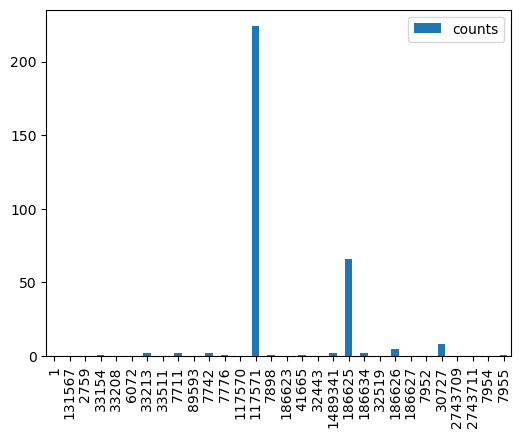
Visualize number of species along query lineage and counts per gene age class
[9]:
# show number of species along query lineage
of_species_abundance

# bar plot number of species along query lineage
of_species_abundance.plot.bar(y='counts', use_index=True)
[9]:
<AxesSubplot: >
[10]:
# show count per taxonomic group (PStaxID)
of2orthomap.get_counts_per_ps(query_orthomap)

# bar plot count per taxonomic group (PSname)
ax = of2orthomap.get_counts_per_ps(query_orthomap).plot.bar(y='counts', x='PSname')
ax.set_title('D. rerio - Number of genes per gene age class')
plt.show()

Use pre-calculated gene age classification
The query species in this part is: Caenorhabditis elegans (nematode).
Any pre-calculated gene age classification can be imported as a table using the function orthomap2tei.read_orthomap(orthomapfile=filename).
The pre-calculated gene age classification file should be delimited with two columns GeneID<tab>Phylostratum, like e.g.:
GeneID<tab>Phylostratum
WBGene00000001<tab>1
WBGene00000002<tab>1
WBGene00000003<tab>1
WBGene00000004<tab>1
WBGene00000005<tab>2
The orthomap for this part was pre-calculated (Sun et al., 2021) and is available here:
https://doi.org/10.5281/zenodo.7242263
or can be accessed with the dataset submodule of oggmap
datasets.sun21_orthomap(datapath='data') (download folder set to 'data').
Note: If you want to use your own OrthoFinder results, please have a look at the documentation of Step 0 - run OrthoFinder.
A detailed description of how to extract an orthomap from OrthoFinder results is described in the first part.
[11]:
datasets.sun21_orthomap(datapath='data')
100% [............................................................................] 344640 / 344640
[11]:
'data/Sun2021_Orthomap.tsv'
[12]:
# get query species taxonomic lineage information
query_lineage = qlin.get_qlin(q='Caenorhabditis elegans')
query name: Caenorhabditis elegans
query taxID: 6239
query kingdom: Eukaryota
query lineage names:
['root(1)', 'cellular organisms(131567)', 'Eukaryota(2759)', 'Opisthokonta(33154)', 'Metazoa(33208)', 'Eumetazoa(6072)', 'Bilateria(33213)', 'Protostomia(33317)', 'Ecdysozoa(1206794)', 'Nematoda(6231)', 'Chromadorea(119089)', 'Rhabditida(6236)', 'Rhabditina(2301116)', 'Rhabditomorpha(2301119)', 'Rhabditoidea(55879)', 'Rhabditidae(6243)', 'Peloderinae(55885)', 'Caenorhabditis(6237)', 'Caenorhabditis elegans(6239)']
query lineage:
[1, 131567, 2759, 33154, 33208, 6072, 33213, 33317, 1206794, 6231, 119089, 6236, 2301116, 2301119, 55879, 6243, 55885, 6237, 6239]
[13]:
# get query species orthomap

# download pre-calculated orthomap here: https://doi.org/10.5281/zenodo.7242263
# or download with datasets.sun21_orthomap(datapath='data')
query_orthomap = orthomap2tei.read_orthomap(orthomapfile='data/Sun2021_Orthomap.tsv')
query_orthomap
[13]:
| GeneID | Phylostratum | |
|---|---|---|
| 0 | WBGene00000001 | 1 |
| 1 | WBGene00000002 | 1 |
| 2 | WBGene00000003 | 1 |
| 3 | WBGene00000004 | 1 |
| 4 | WBGene00000005 | 2 |
| ... | ... | ... |
| 20035 | WBGene00305132 | 9 |
| 20036 | WBGene00305157 | 1 |
| 20037 | WBGene00305158 | 13 |
| 20038 | WBGene00305159 | 11 |
| 20039 | WBGene00305173 | 0 |
20040 rows × 2 columns
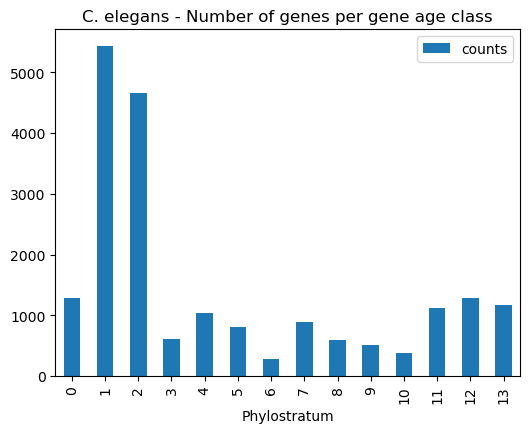
Gene age assignments per query species lineage node
Given a pre-calculated orthomap, one can still get an overview of the gene age assignments per query species lineage node.
However, since it might be that some columns are missing which normally are produced by the of2orthomap.get_orthomap()function, the column names need to be set specifically with the of2orthomap.get_counts_per_ps() function to visualize the distribution of the gene age classes as follows:
[14]:
# show count per taxonomic group (Phylostratum)
of2orthomap.get_counts_per_ps(omap_df=query_orthomap,
    psnum_col='Phylostratum',
    pstaxid_col=None,
    psname_col=None)
[14]:
| Phylostratum | counts | |
|---|---|---|
| Phylostratum | ||
| 0 | 0 | 1290 |
| 1 | 1 | 5434 |
| 2 | 2 | 4666 |
| 3 | 3 | 603 |
| 4 | 4 | 1039 |
| 5 | 5 | 808 |
| 6 | 6 | 274 |
| 7 | 7 | 884 |
| 8 | 8 | 590 |
| 9 | 9 | 511 |
| 10 | 10 | 384 |
| 11 | 11 | 1113 |
| 12 | 12 | 1277 |
| 13 | 13 | 1167 |
[15]:
# bar plot count per taxonomic group (Phylostratum)
ax = of2orthomap.get_counts_per_ps(omap_df=query_orthomap,
    psnum_col='Phylostratum',
    pstaxid_col=None,
    psname_col=None).plot.bar(y='counts', x='Phylostratum')
ax.set_title('C. elegans - Number of genes per gene age class')
plt.show()
If you like to continue, please have a look at the documentation of Step 3 - map gene/transcript IDs to get further insides.